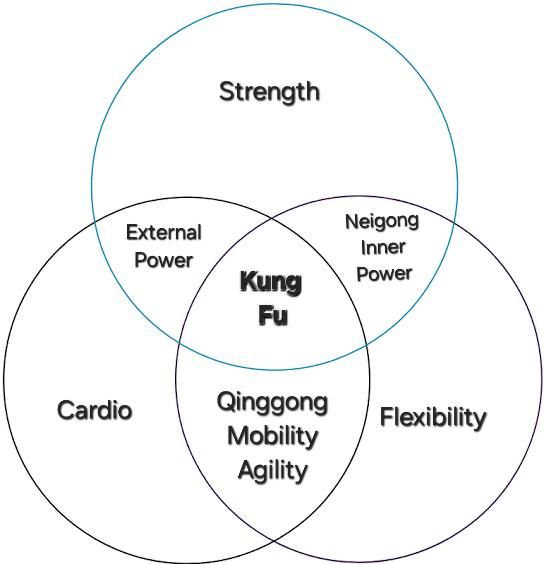
In this Issue, we explore the Classical Kung Fu triumvirate, which is my personal brand of Kung Fu. While I am not the patent holder of the term “Classical Kung Fu”, I am perhaps a rarity of an austere and older tradition regarding how we culturally view Kung Fu in society, if not in Warfare (which is where the term _Wugong_ is more aptly applied).
Why is the Venn Diagram, which I made for our purposes, a signifier of Classical Kung Fu? That is because of the neigong component which comes from diligence and hard work, as well as personal cultivation. Instead of fancy forms, ie dance choreography, and a formal lineage, Classical kung fu is about the components of how established one can become regarding their abiltiy to manipulate energy. When we say energy, it’s about forces, or even physics, because manipulating it externally via a weapon or through another person is a sign of skill, and manipulating internally represents the depth of self-awareness. In this sense, a Classical Kung Fu practitioner is, at their essence, a super-human, one capable of performing unusual feats of athleticism. The practitioner’s chosen form of combat is inconsequential, as “anything can be kung fu”, and as long as one is aware of the underlying manipulation of energy, then style is simply arbitrary.
Now, enough preamble, let’s get into the details of the Venn Diagram!
~~~
While the chart is self explanatory, I will ensure that there is less chance for shallow interpretation by exploring the components.
*Strength*: Is nuancely different to Power, but it refers to the ability to output energy. More Strength is generally more force, but there are caveats to that, and doesn’t necessarily equate to more Power.
*Cardio*: It is your fitness level. Simple, yet so overlooked in modern kung fu circles as we can see from kung fu fighters vs mma fighters. This element is the durational output of energy.
*Flexibility*: This term can mean different things to different people, but let’s simplify it by defining the term as “control of energy, or range and scope of energy”.
~~~
So we have Max Energy Output (Strength), Energy Duration Period (Cardio), and Range of Energy (Flexibility). When we combine any two, we now approach the sub elements.
Strength + Cardio = External Power:
MMA isn’t solely reliant on this aspect, but it has been evident that primarily Combat Sports use this, and they use it well. Of course, that is not to say that they do not use internal power, but simply that they [generally] do not manipulate energy to the same degree as internal practitioners. To put it crudely, they generally add more fuel instead of using fuel as effectively as possible. But this method is valid, easier to learn, and offers quick, measurable results.
Strength + Flexibility = Internal Power: Associated with health benefits, the myth that Internal Power isn’t meant for combat belies the fact that Internal Power, neigong, isn’t _solely_ focused on combat. If External Power is about getting bigger, Internal Power is about a becoming more solid- size isn’t the determining factor for power. The Sport Science view describes that the 2 ways humans gain strength is via muscle growth, or neural activation, and we see this aptly parallels External Power vs Internal Power. Internal power is about saturating the body, via the tendons, muscles, ligaments, bone marrow, with energy, and increasing the scope of how we manipulate energy internally; this in turn, allows us to better manipulate energy externally, such as through a weapon, progressing to compliant partners, and finally with a resisting opponent.
Cardio+ Flexibility = Qinggong (Mobility Skill): The mobility skill is a distinctly separate one compared to the previous two. Qinggong is less about resistance against objects/people, and more about resistance against gravity. This can apply to how we distribute force internally in various positions, and how deftly we can make use of live momentum.
With the combination of External Power, Internal Power, and Mobility, we can reach the stage of a ‘Master’. Caveat: This refers to a generalist approach to mastery, but specialists in any of the fields can also achieve the status of a Master (depending on how well they can use their speciality).
~~~
Under the Classical Model, we can see why the ultimate expression of martial arts is “Formless”, and that only focusing on correctness in our techniques is not the most supreme objective for kung fu training: Comprehension eclipses Roteness. However, there is definitely something to be said about one who has mastered a technique, for in doing so they will invariably touch upon the way we describe energy manipulation.
As long as one does not become limited in their approach, then every Path/Tao is valid!
 Solosopher & Solosophy